
Know Your Status, Share With Confidence: Building a Safe Space For Sexual Health
Empowering individuals to build connections and manage their sexual health with confidence and privacy.
OVERVIEW
The landscape of sexual health management is confronting unprecedented challenges, leading to a surge in sexually transmitted infections (STIs) globally and compromising public health outcomes. Astonishingly, according to the WHO the world witnesses a staggering 1.5 million new cases of STIs reported daily, reflecting the inadequacy of current approaches in curbing transmission rates and facilitating timely treatment.
Addressing these challenges demands urgent innovation and comprehensive solutions that can effectively curb transmission rates, and enhance access to sexual health services. Portaul stands ready to address this critical need and provide an equitable solution.
THE GOAL
The goal is to create an app that makes sexual health management seamless, secure, and approachable while fostering an environment of trust and empowerment.
ROLE
Sole Product Designer - User Research, Interaction, Visual design, Prototyping & Testing
August 2024 - October 2024
The Problem
1. Asymptomatic Spread of STIs: Many sexually transmitted infections (STIs) present a significant challenge as they can spread silently without obvious symptoms. Shockingly, data from the European Centre for Disease Prevention and Control (ECDC) indicates that over 70% of women and 50% of men infected with chlamydia show no signs of the infection. This silent transmission perpetuates widespread unawareness of infection status among individuals, heightening the risk of further transmission and increasing the likelihood of complications from untreated STIs.
2. Stigma & Privacy Concerns: Navigating the challenges of stigma and privacy in sexual health can be daunting. Individuals often face judgement and discomfort, especially when broaching the topic with new acquaintances or seeking advice and testing. This reluctance perpetuates misconceptions and hampers effective sexual health management.
3. Outdated Partner Notification Systems: The current state of partner notification systems for STIs presents a critical bottleneck in our collective efforts to combat the spread of infections. These systems rely on manual inputting of partner details, resulting in a shockingly low disclosure rate of less than half of individuals. This antiquated process not only fails to promptly notify at-risk individuals but also perpetuates the cycle of infection transmission.
The Design Process
My design process for portaul is based on the Double Diamond Theory and Lean UX process. I aim to incorporate the key phases of Discovery, Definition, Ideation and Implementation in the projects.
.png)
Understanding The User
The initial phase of the UX design process involved a comprehensive exploration of the challenges users faced with managing their sexual health. The primary goal of the user research was to understand the needs, challenges, and preferences of potential users regarding sexual health communication and management.
My research encompassed:
-
Understanding the user's goals and needs
-
Uncovering pain points with the existing user journey
-
Determining the success of the tasks measured
i. Users Interview
Conducted one-on-one interviews with 10 Individuals between the ages of 18 - 45 with diverse demographics and sexual health experiences, including both frequent and occasional users of the existing platforms.
Interview Questions:
-
Can you describe your experience managing your sexual health? What tools or resources do you currently use?
-
What challenges do you face when sharing STI result or any sexual information with partners?
-
How important is privacy and security to you in a health app?
-
What features would make you feel more comfortable managing your sexual health?
-
How do you currently track your STI testing schedule, and what motivates you to stay consistent?
ii. Quantitative Survey
Distributed surveys to a broader audience to gather statistical insights about user behaviors, preferences, and challenges related to sexual health communication and management. Questions were designed to assess overall satisfaction, identify specific pain points, and gauge interest in potential new features. Survey participant were a diverse group of 200 participants aged 18-45 with varying levels of familiarity with health apps and sexual health management.
Insight gathered
After collecting the recordings from the user interviews and survey, I conducted affinity mapping to synthesise the pains identified. We grouped these problems under common themes and features in the platform.

1. Privacy Concerns:
-
Users expressed a strong need for privacy, emphasizing that they want complete control over who accesses their information.
-
Many users appreciated the concept of mutual consent for sharing STI statuses.
-
90% rated privacy as "very important," reinforcing the app’s focus on secure data handling.
2. Stigma Barriers:
-
Over 60% admitted hesitance in sharing STI statuses due to stigma, highlighting the importance of normalizing conversations.
-
Participants highlighted the stigma around sexual health discussions, suggesting the app should normalize such conversations through friendly and non-judgmental design.
3. Automated Updates and Reminders:
-
Discreet notifications for potential STI exposures were seen as valuable, provided they were anonymized and did not induce unnecessary anxiety
-
Personalized reminders and gamified challenges were suggested as effective ways to encourage regular testing.
-
Users wanted educational resources integrated into the app to better understand STI risks and prevention.
Building Empathy
Using the quantitative and qualitative data from interviews and survey results, I defined the two target group profiles to better empathize with my main user groups and prioritize goals according to their needs.


Competitive Analysis
The competitive analysis highlights a diverse and evolving landscape in the world sexual health management. Portaul was compared with other sexual health and wellness apps to identify unique strengths, gaps, and opportunities for differentiation. The key focus areas were verified STI status sharing, automated exposure update, privacy, user experience, and innovative features.

Wireframing The Solution
Based on the above problems identified, I worked towards addressing these pains by coming up with potential solutions:
1. Secure & Verified Sexual Health Status Sharing
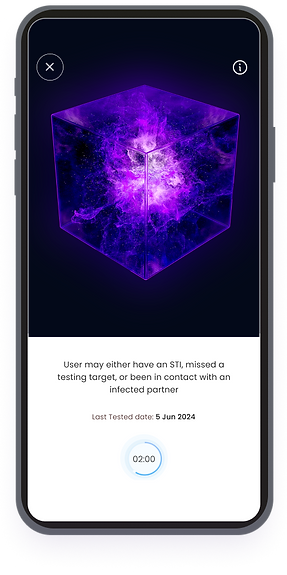
Offer a unique and user-friendly feature for secure and verified STI status sharing. Users can share their test results through the app using approachable and easy-to-understand 3D shapes: a purple cube, a blue pyramid, and a green sphere. This visual representation empowers individuals to proactively manage their own sexual health in a non-invasive and intuitive manner. Each status is shared via Scaning QR codes and one-time-use codes with a timeout feature, ensuring that other users do not have permanent access to the results. Moreover, explicit consent is obtained from both parties before any STI status is exchanged, maintaining privacy and fostering a trust-based environment.
2. Next Gen Automated STI Exposure Updates
Offer automated anonymous STI exposure updates optimised for testing windows, ensuring accuracy and reliability. When a user receives an exposure update, the app only accepts a negative test result if it is taken after the appropriate testing window for the specific STI. This feature enhances the accuracy of the results and ensures timely and appropriate testing. Additionally, users can search for their nearest testing clinic or self-testing suppliers based on age and postcode.
3. Personalised STI Testing Schedules
Offer personalised STI testing schedules tailored to each user's lifestyle and level of activity using national guidelines. By providing customised reminders and engaging challenges, the app keeps users motivated to maintain their sexual health. This feature ensures that testing remains a proactive and consistent part of their routine, enhancing overall well-being and promoting a responsible approach to sexual health.
4. Trust Circle
Portaul's Trust Circles build a supportive network for managing sexual health. These customisable groups, provides a safe space for open communication with friends or partners. Users can work together to set goals, track progress, and view each other's STI statuses within the group – all with complete privacy control. Automated reminders can nudge users about upcoming or missed testing schedules, keeping communication smooth. Trust Circles help users manage their sexual health collaboratively and transparently, while still giving them complete control over their privacy.
.png)
Validating the designs
I conducted usability testing sessions with our foucus group whether the new designs would solve their problems. I wrote a script including a scenario asking the user to share their STI statuses.
During the session, I observed how participants interacted with the prototype and used the "one time code" functionality to share their statuses. Users found it intuitive to locate necessary options, with advanced features being conveniently tucked under collapsible sections. This approach minimized confusion and enhanced the overall user experience, making status sharing seamless and less intimidating.
How Portaul Status Share Works
From real stories to real solution.
Case scenario: Elena, a recent graduate, just landed in the city and she is meeting someone new.
Step 1: Elena signs up and gets a recommended STI testing schedule every six months. She uploads her latest test results.
Step 2: Elena's date went well. Before their next date, to avoid an awkward conversation , she asks if Dave is on Portaul. He says no, but agrees to download the app.
Step 3: Using unique a “port codes”, they instantly exchange their STI status, represented by anonymous 3D shapes that time-out.
Step 4: They are automatically added to each other’s contact history. For privacy, Elena turns off her name display.
Step 5: If Dave tests positive for an STI in the future, Elena gets an automated update to get tested.
Portaul 3D Signal Shapes
Portaul uses anonymous 3D shapes which time-out, as a way for users to privately communicate their results with each other. Allowing users to grasp results at a glance. Making test results sharing suitable for any setting.

Portaul App Beachhead Persona User Flow

Visual Designs



Video Prototype
Conclusion
The Portaul project highlighted the importance of addressing stigma, privacy, and usability in designing digital solutions for sensitive health management. Through comprehensive user research and iterative testing, the app achieved a user-centered design that simplifies STI management and fosters open, empowered communication. Key features like status shares and personalized/automated reminders have positioned Portaul as an innovative solution in the sexual health space, offering users a sense of control, security, and support.
The positive feedback during usability testing reinforced the app’s relevance and its potential to transform how individuals manage and communicate their sexual health.
Future development will focus on expanding features, incorporating community-driven support, dating app integration and continually refining user experience based on real-world feedback.
Learnings
1. The Power of Privacy in Design: Privacy concerns are paramount in health-related apps. Users are more likely to trust and engage with platforms that prioritize secure data handling and mutual consent mechanisms.
2. Reducing Stigma Through Design: Thoughtful, non-judgmental design can play a significant role in normalizing conversations around sensitive topics. Visual simplicity and approachable interfaces help to dismantle barriers and encourage user interaction.
3. The Value of Personalization: Tailored reminders, educational content, and gamified elements significantly enhance user engagement and promote proactive health management.
4. Iterative Testing Drives Success: Conducting usability tests and iterating based on feedback ensures the final product aligns with user needs and expectations. Each refinement, whether small or significant, contributes to a more seamless and intuitive experience.
5. Collaborative Insights Shape Better Outcomes: Incorporating user feedback, stakeholder input, and interdisciplinary research fosters a well-rounded solution that addresses technical, emotional, and practical user needs.